Shaped by Experience. Engineered to Go Far.
Shaped by Experience
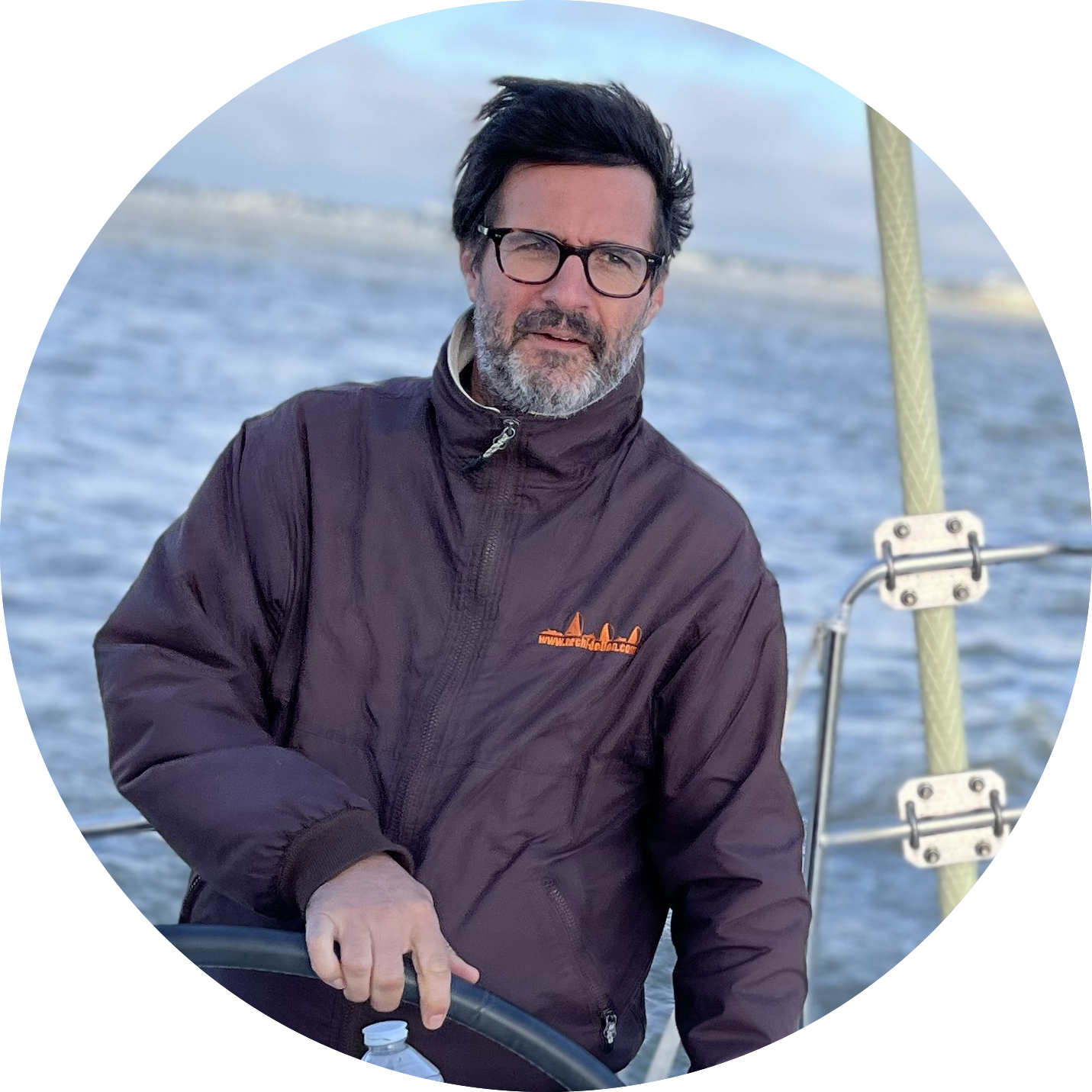
After 11 years at sea and roughly one and a half circumnavigations, one lesson became clear: offshore sailing isn’t about peak performance in ideal conditions. It’s about sustaining high average speeds with a fully loaded boat, a short-handed, tired crew, and conditions that are rarely clean or predictable.
Over time, it also became clear that many boats sail well when lightly loaded and in flat seas. Far fewer are designed to carry real cruising loads without sacrificing speed, control, or confidence.
Introducing the
NAHOA M
The Brief
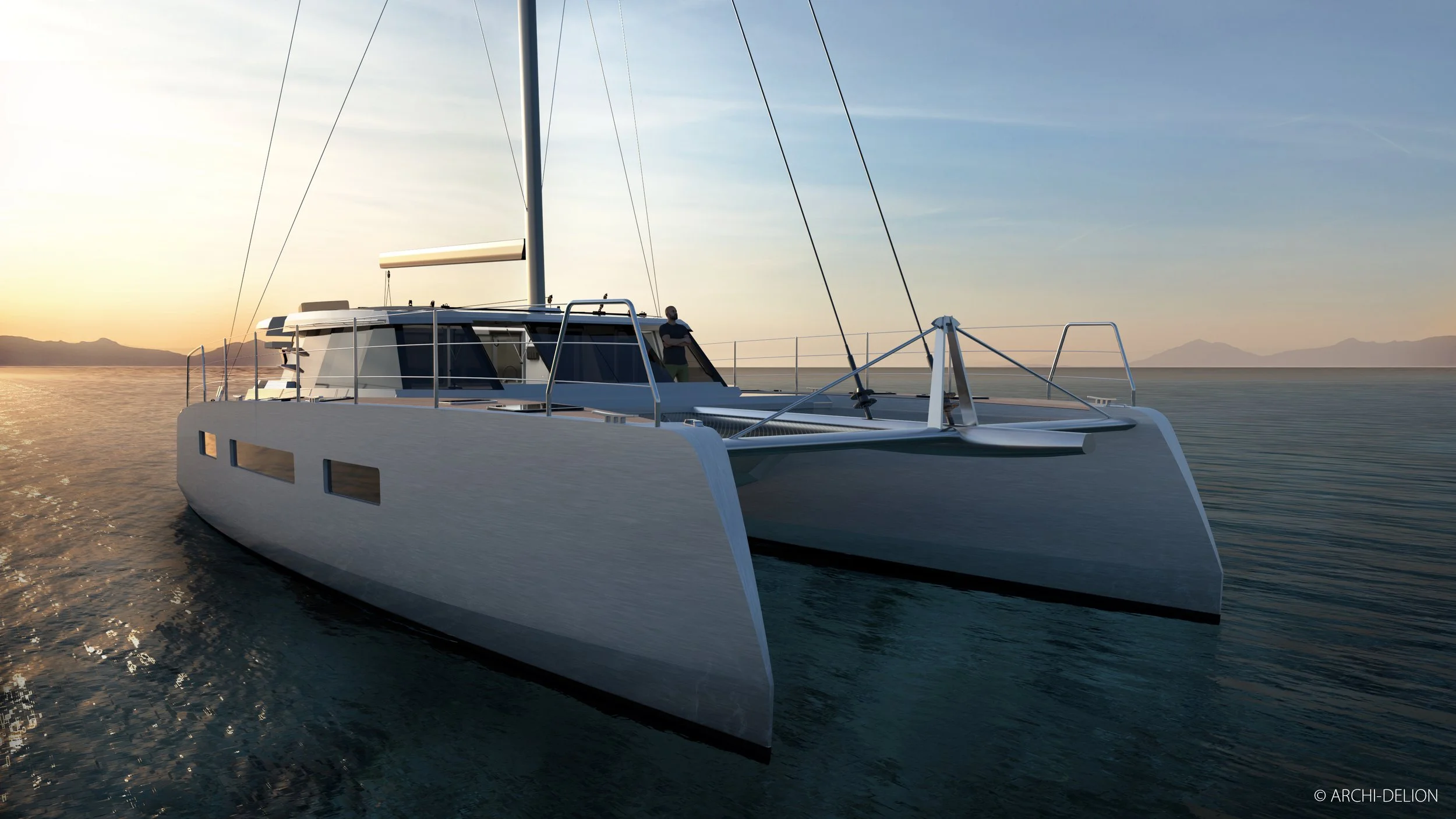
Nahoa M is the first model in the Nahoa Yachts range. It defines the platform on which future models — Nahoa L and Nahoa S — will be built, each scaled deliberately but guided by the same offshore-first design philosophy:
The design brief was clear: maintain high average speeds with a full cruising load, remain controllable and predictable in messy offshore conditions with a short-handed crew, and stay simple enough to operate and maintain far from supply chains and shore-side support.
The interior volume is deliberately restrained to that of a cruising 50-foot catamaran, keeping systems compact, accessible, and easy to live with over time. The rig is sized and loaded like a 52 — manageable by a short-handed crew, predictable in squalls, and conservative in its loads.
The hulls carry true expedition loads without penalty, while the long, efficient waterline delivers the high average speeds more typical of a 57-foot platform.
At the core, the boat had to inspire confidence — a platform that feels like a fortress when conditions deteriorate, not a liability to manage.

“We want to go anywhere..”
We didn’t design this boat around a destination or a season.
Real freedom is being able to put your finger on a map and say, “we’re going there” without second-guessing the boat.
The Nahoa M gives us that freedom.
Design Philosophy
Every decision comes back to three things: Simplicity, Strength and Safety.
Simplicity breeds confidence. Intuitive systems reduce dependence on specialists and shore-side support. When something does go wrong, you can understand it, fix it, and keep moving — even in the most remote places.
Strength comes from aluminum — a material proven by decades of ocean miles. It’s repairable anywhere on earth, and it doesn’t just survive the unexpected; it invites you to go looking for it.
Safety is built into every design and outfitting decision - from watertight bulkheads to the absence of through-hulls in accommodation spaces.
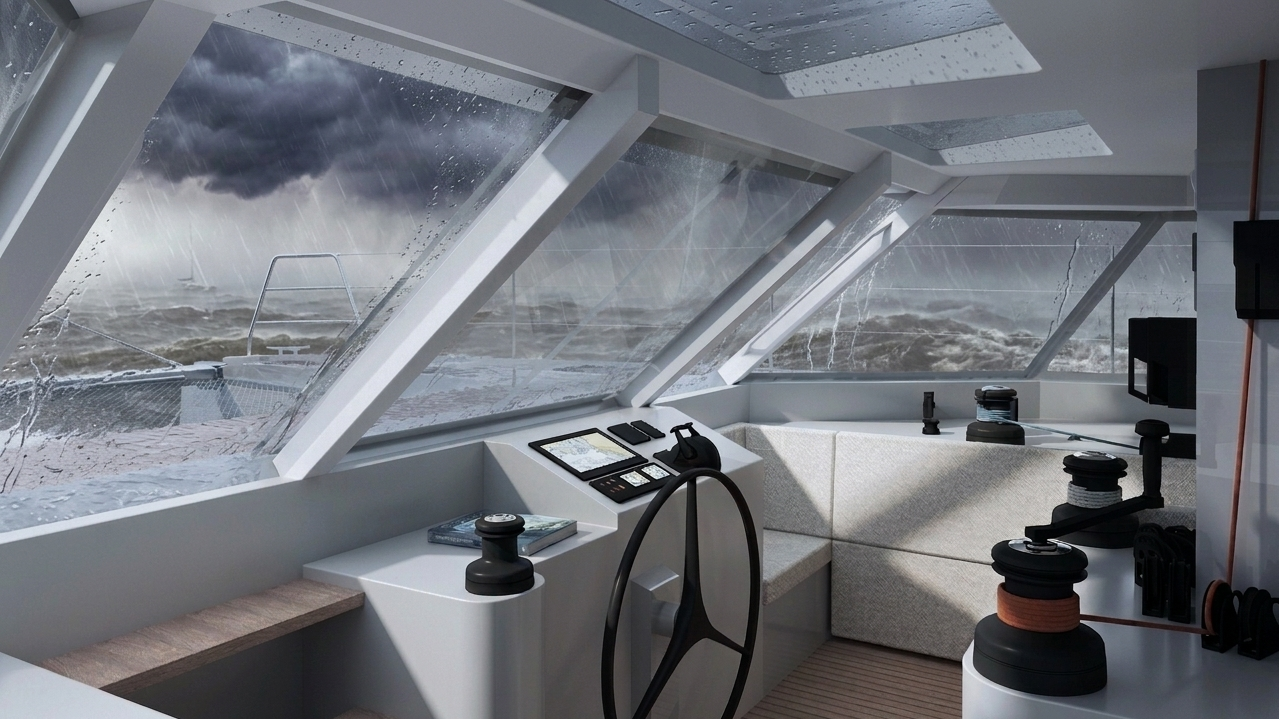
The Control Hub
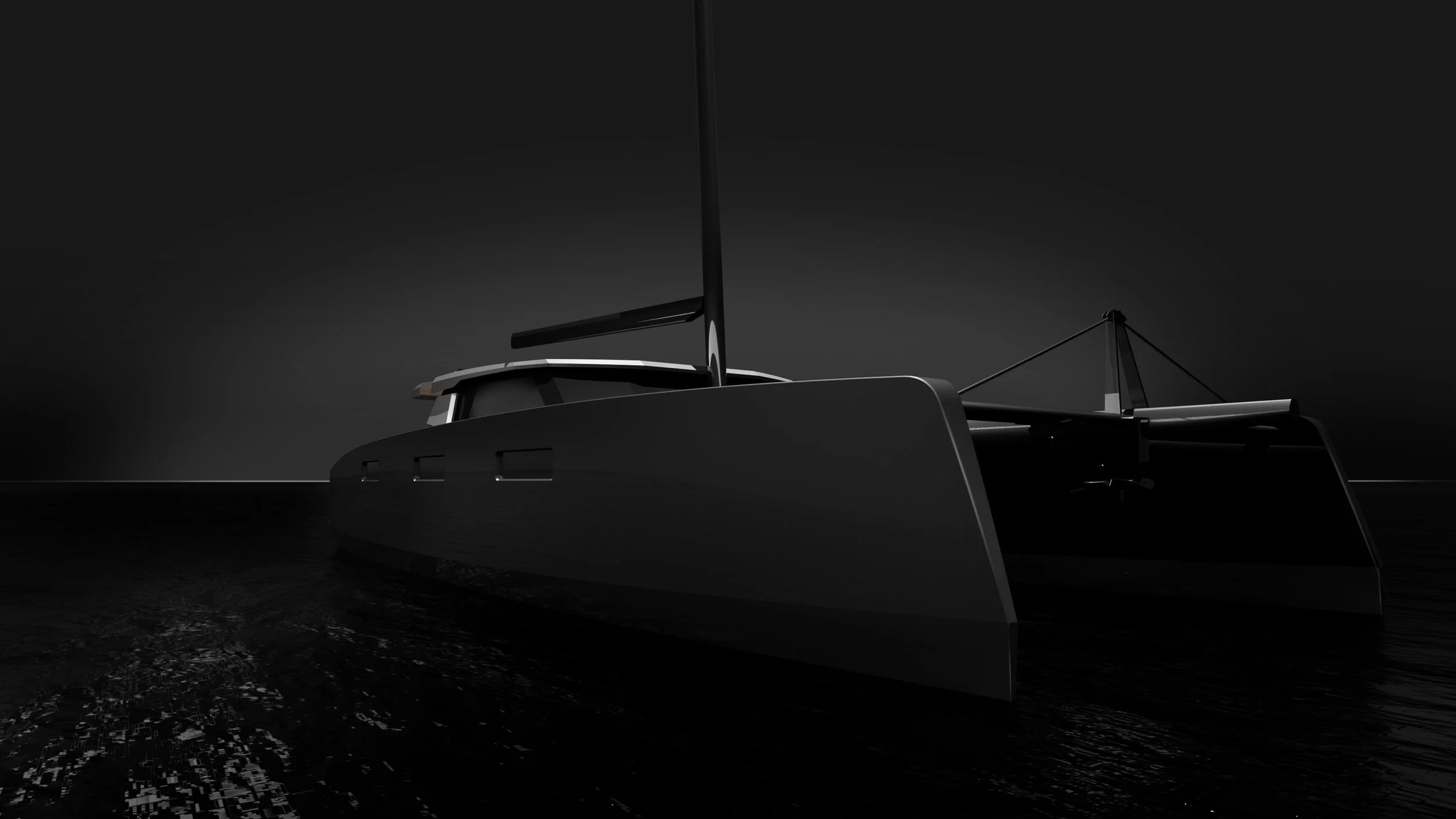
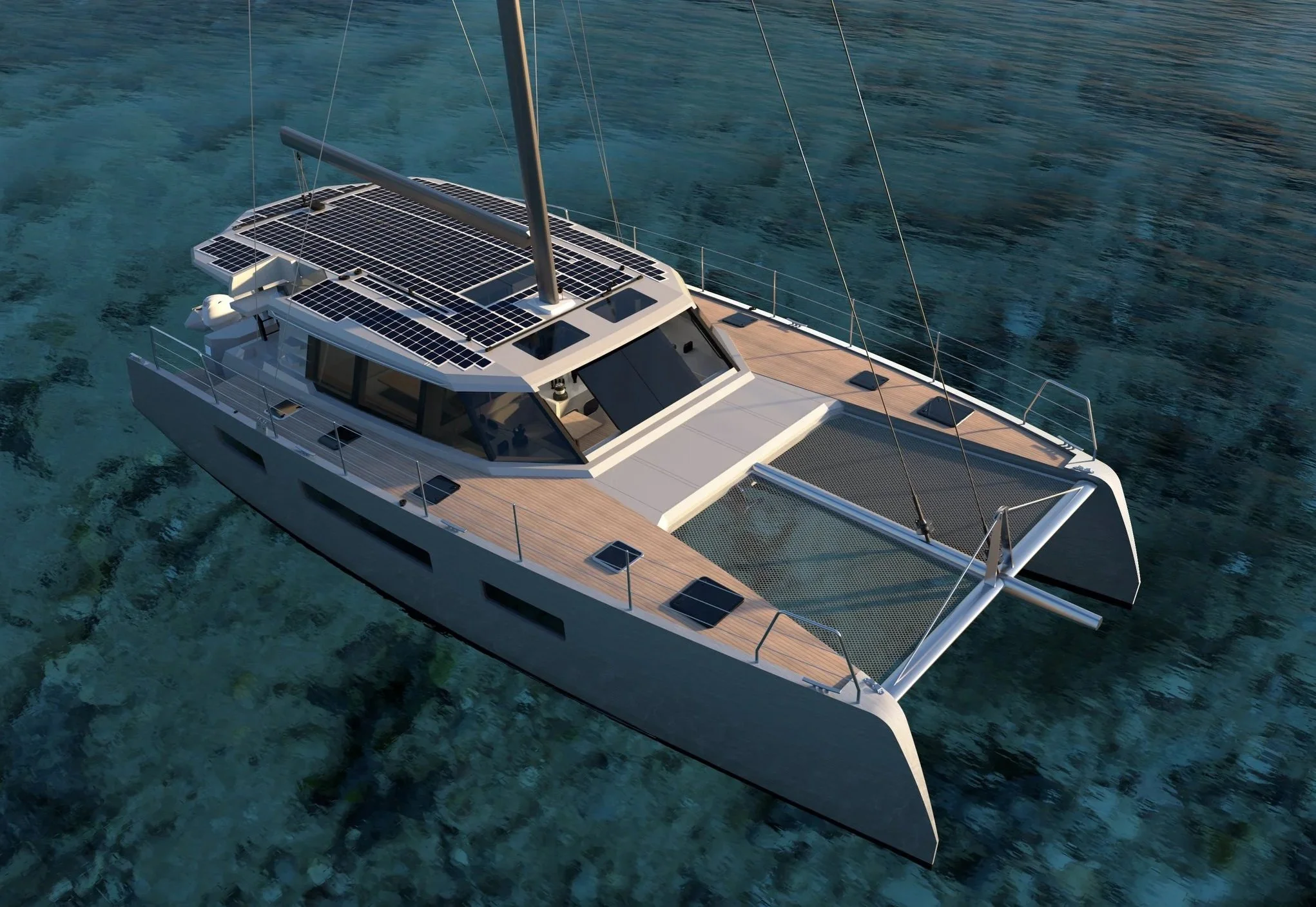
Unlike traditional cockpit layouts where steering, sail controls, and navigation are scattered across the boat, the Control Hub brings them together in one protected forward command position.
From here the crew can steer, manage sails, monitor navigation, and communicate easily while remaining sheltered from the elements.
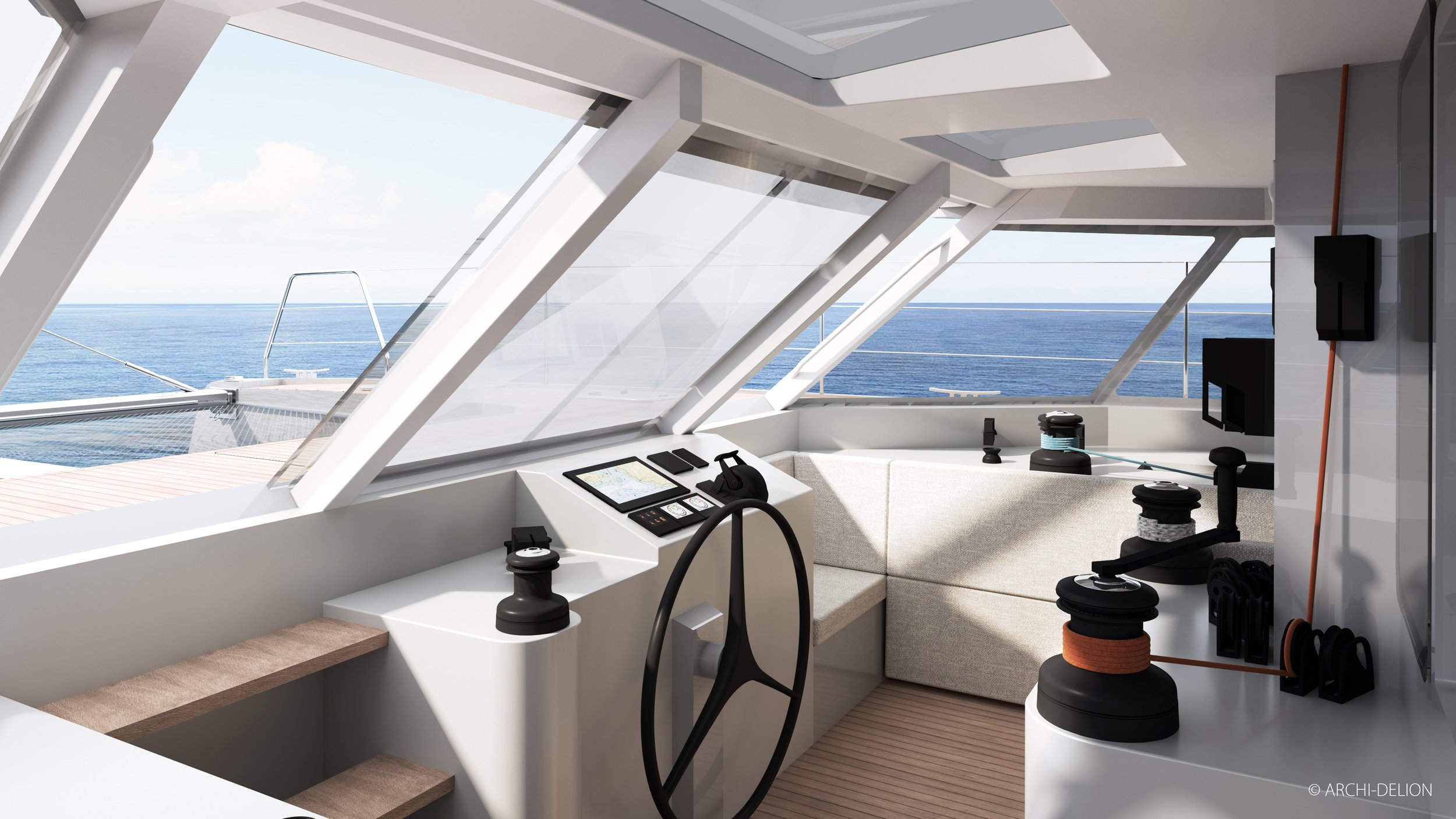
One Control Hub | All Environments
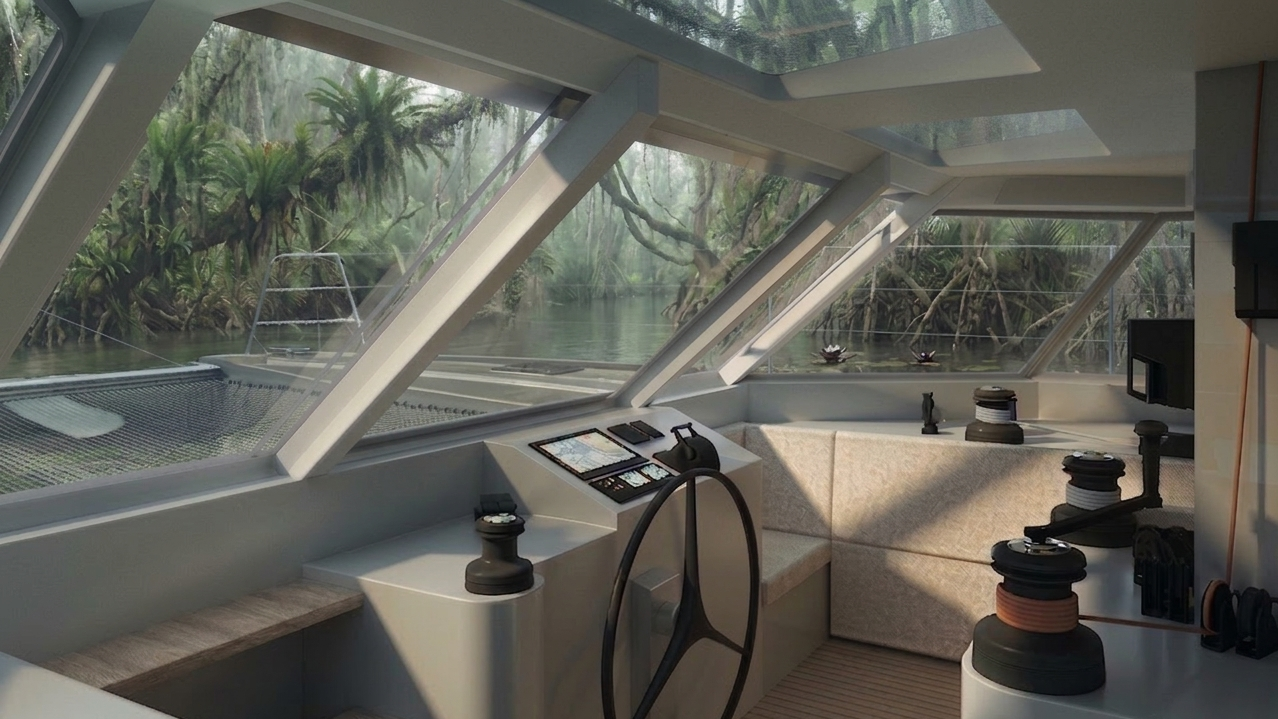
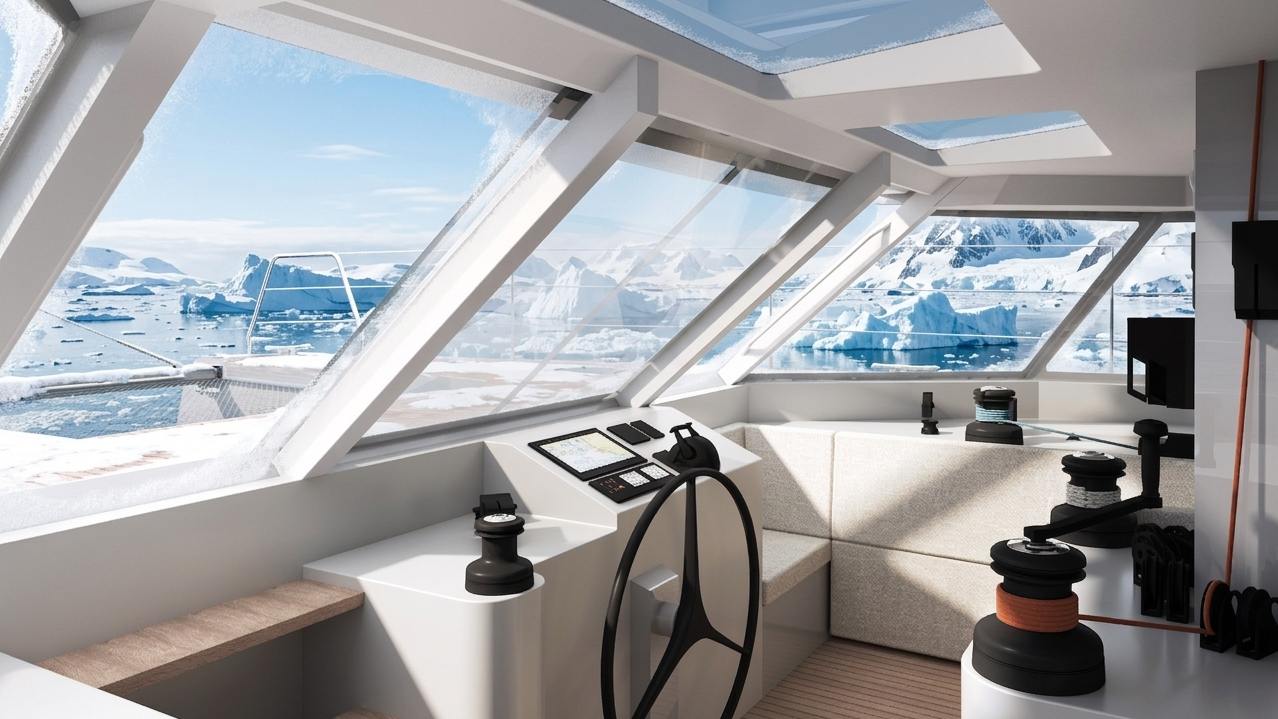
Protected when it’s rough, naturally ventilated in the tropics, and positioned for full control offshore.
Technical Overview
Design & Construction
Naval Architect:Pierre Delion
Construction: Marine Grade Aluminum
Certification: ISO Category A (10 persons)
Build Standard: CE Category ADimensions:
Length Overall (LOA): 17.4 m 57 ft
Waterline Length(DWL): 16.8 m 55 ft
Beam: 8.3m 27.2 ft
Draft: 1.6m 5.2 ft
Displacement:
Light Ship : 21,050 kg
Max Loaded Ship: 27,660 kg
Diesel Capacity: 1,600 Litres
Motoring Range (real world scenarios):
3,000 nautical miles @ 5 knots
2,000 nautical miles @ 6.5 knots
1,000 nautical miles @ 8 knots
Propulsion & Systems:
Engines:Twin 80HP Diesel
Drive: Shaft with V-Drive
Fuel Capacity: 1,800 L
Solar Capacity: 5 kW+
Sail Plan:
Mainsail: 94 m²
Genoa: 78 m²
Staysail: 39 m²
Gennaker: 190 m²
Real World Sailing Performance:
~9–10 knots @ 120–140° TWA in 15–20 knots of wind

General Arrangement
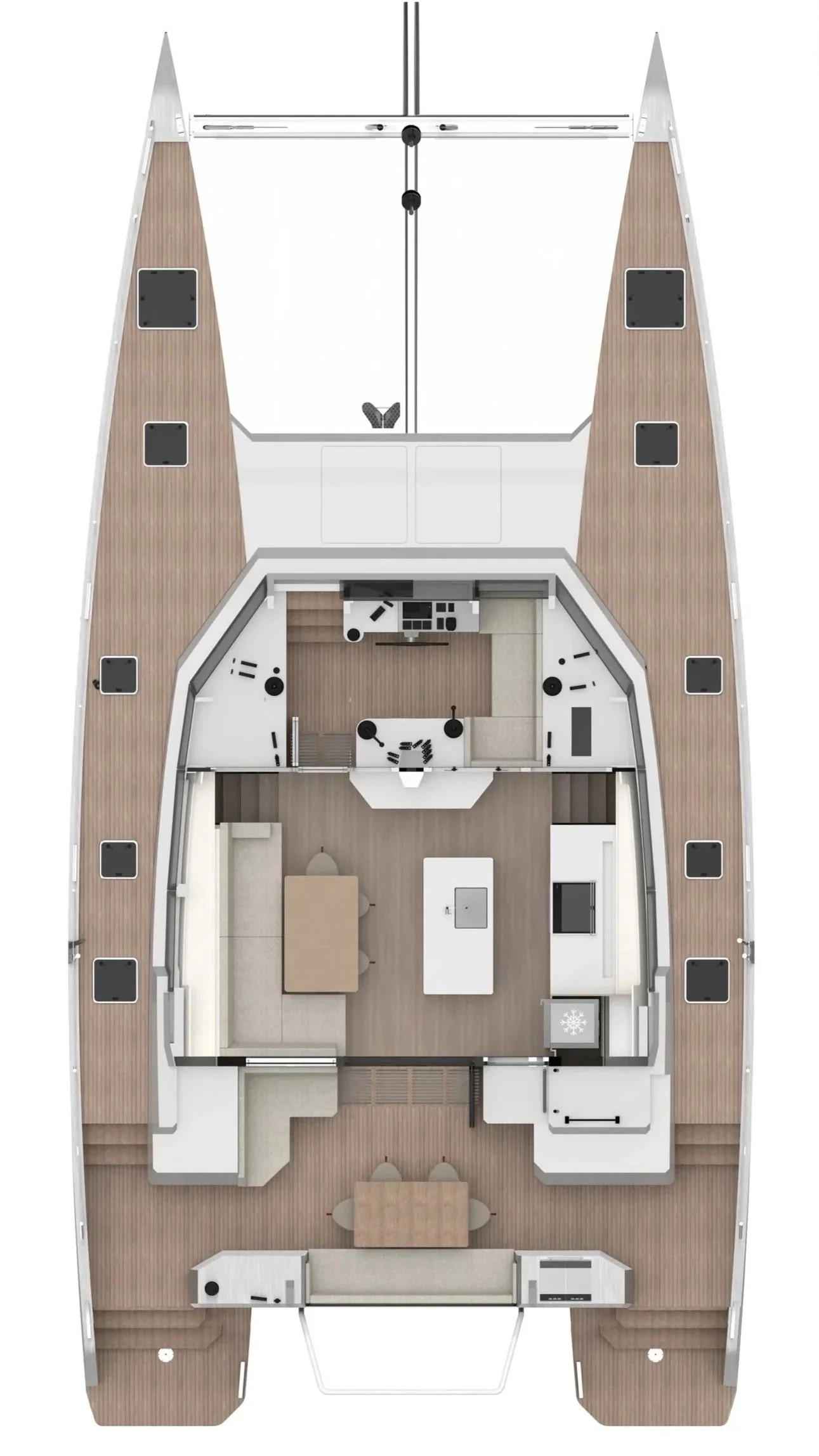
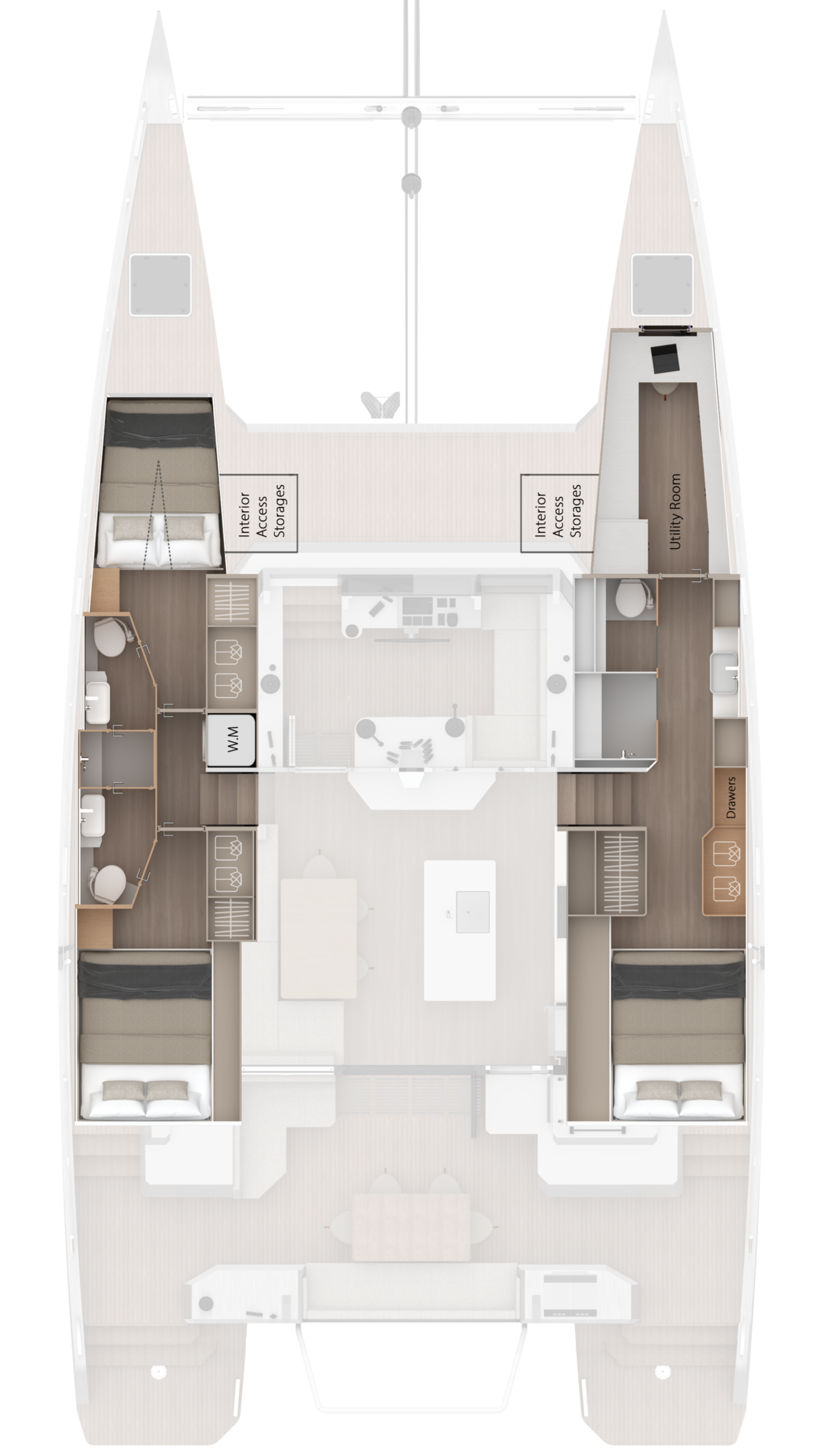
Main Deck Living
Connected Living Space
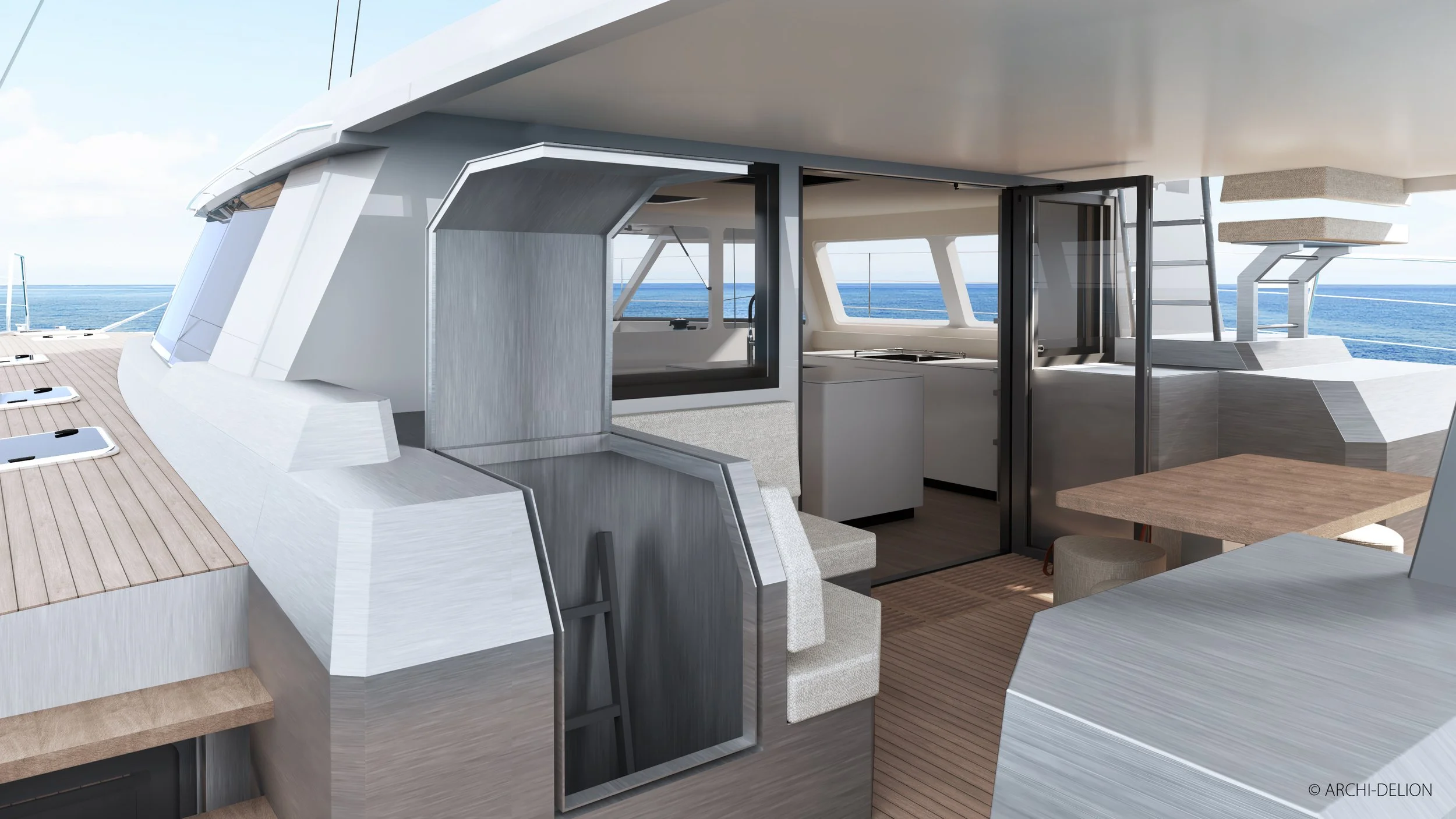
The saloon and galley flow directly into the forward cockpit, creating a single, open living area.
Large openings and dual sliders allow constant airflow — keeping the space naturally ventilated and comfortable in tropical conditions.
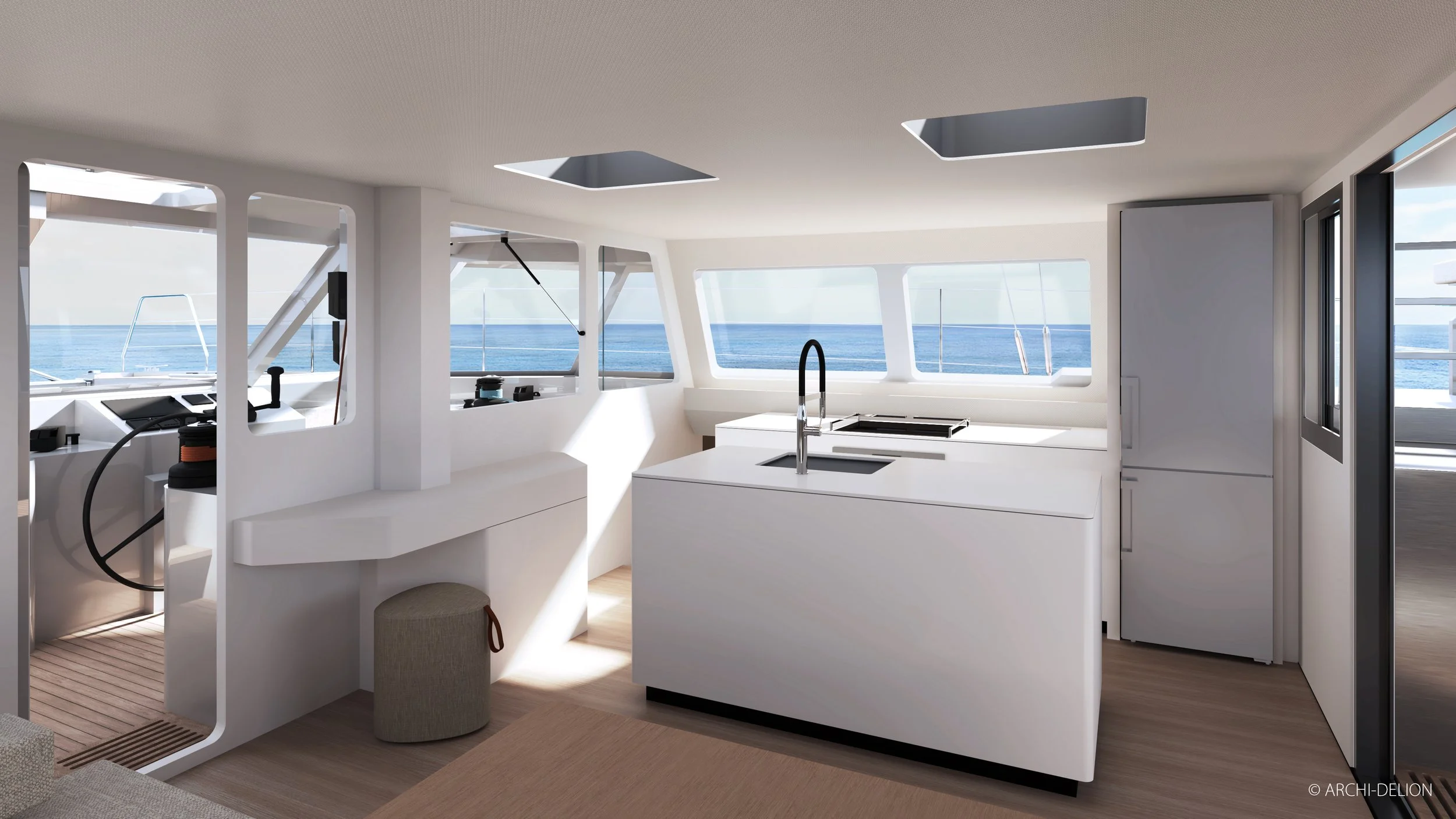
Ventilation & Visibility
The aft cockpit provides a second open-air living zone with clear sightlines and direct connection to the watch station to starboard.Open fore-and-aft airflow paths create natural cross-ventilation through the entire deck, while the layout supports both dining and relaxed use at anchor.
Direct Systems Access
On most production catamarans, the engine lives under a hatch in the cockpit floor. On your knees, leaning into a dark hole, nowhere to put your tools. Offshore, far from help, that is not a minor inconvenience.
The Nahoa M mechanical space is accessed via a full-height door. You step in, stand up, and work. Both engines, the watermaker, pumps, battery bank, and all critical systems are centralised in one place.
If you can see it, you'll maintain it. If you can reach it, you can fix it.
What lives in the mechanical space:
Twin 80HP diesel engines with V-drive transmission
Watermaker and pre-filters
Domestic and system pumps
Generator (optional)
Air conditioning
Dedicated workbench space for tools and spares

Flex Room
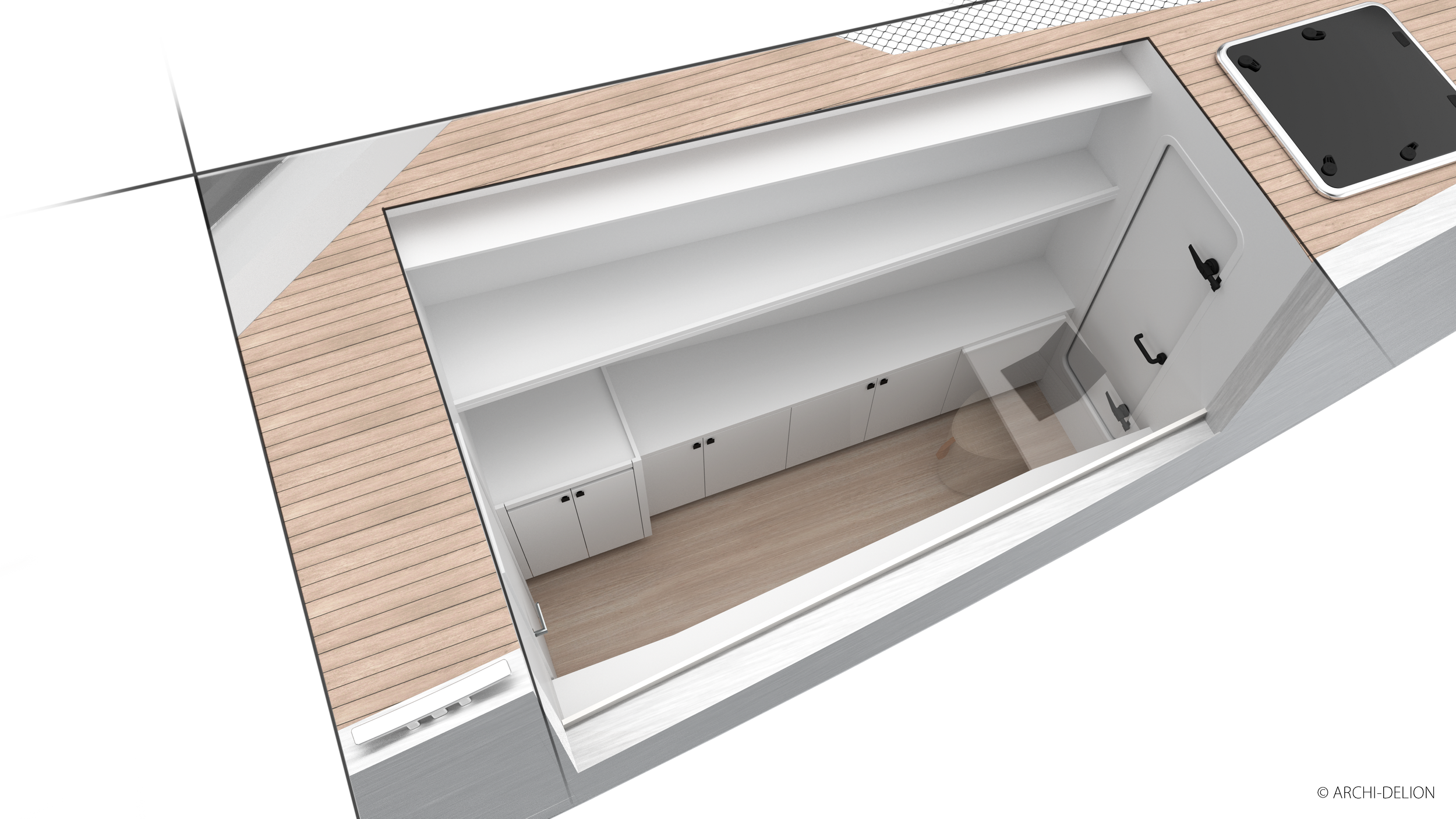
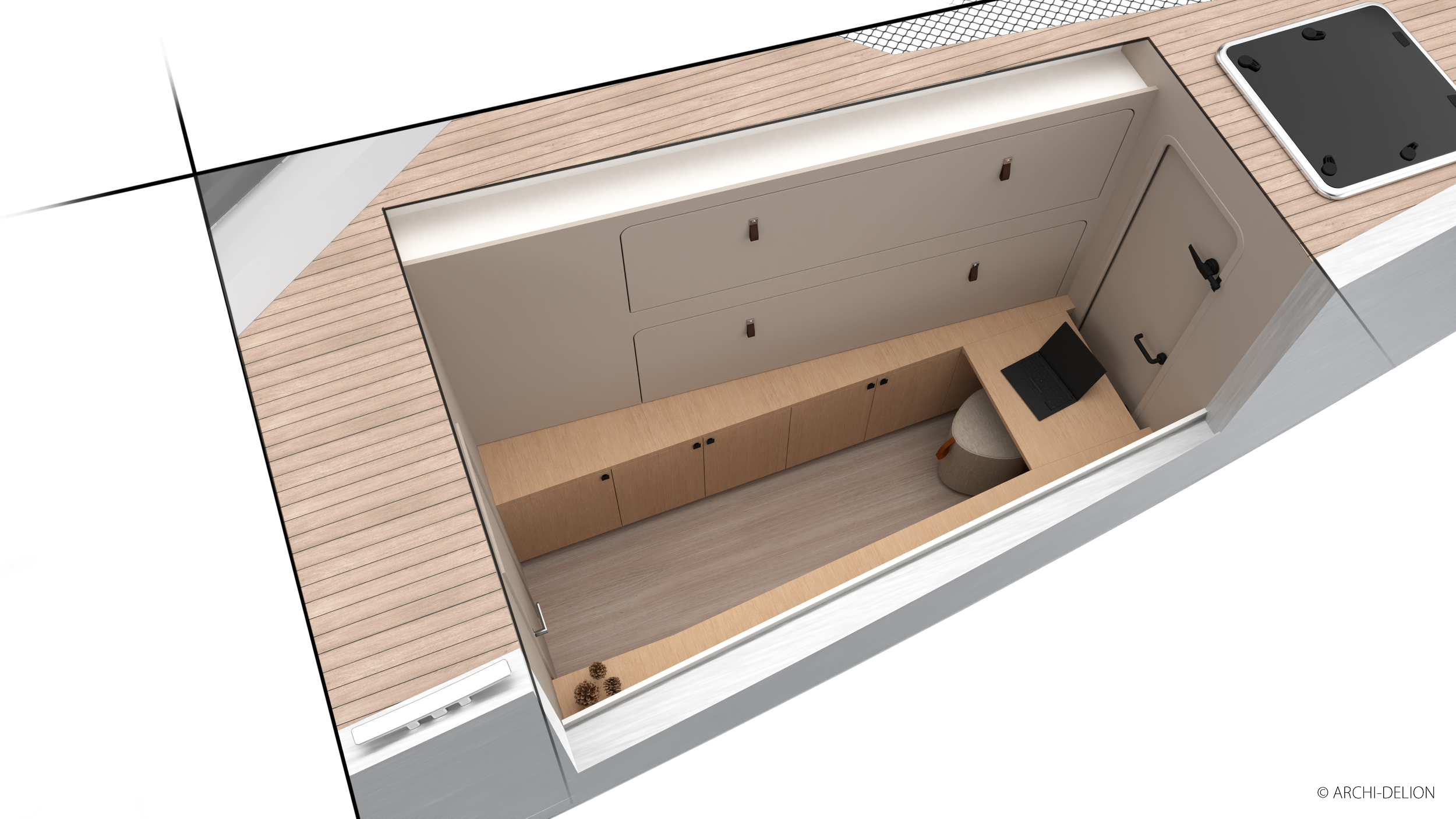
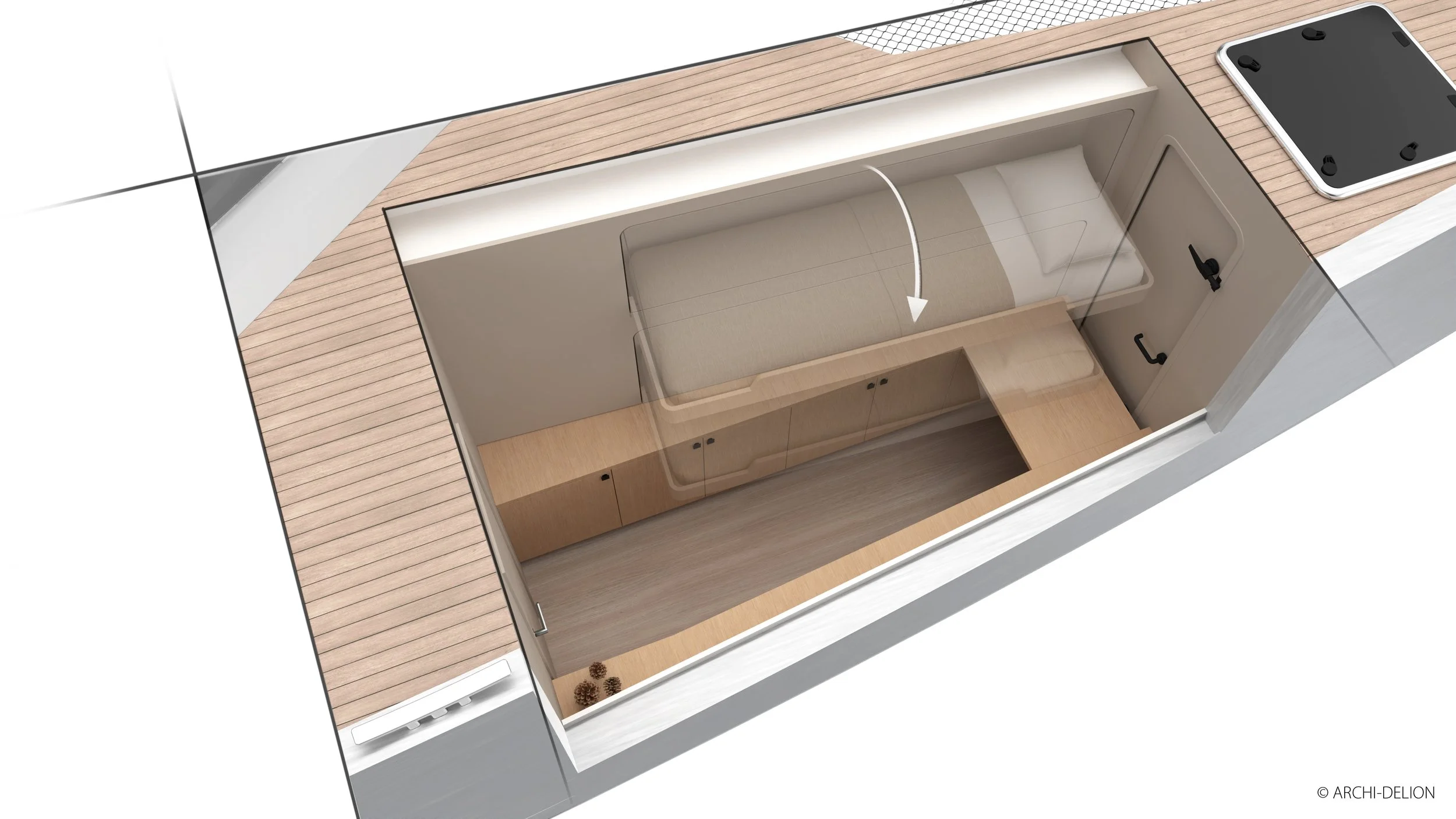
The Nahoa M's forward starboard cabin is a configurable space that can be adapted to each owners needs.
Basic Office option
The expedition default. Open shelving, cabinetry, and space for spare parts, foul weather gear and provisions. Organised and accessible — without eating into your living space.
Bunk Bed Option
When crew joins or the kids grow up, the flex room converts to a private berth. The sequence is simple — fold down, lock in, done. A self-contained cabin that earns its space offshore and at anchor.
Office Lounge option
At anchor, the flex room becomes a private retreat. A dedicated lounge bench, desk space, and separation from the rest of the boat. For owners who work remotely, this is where that happens. For everyone else, it's simply somewhere to disappear.
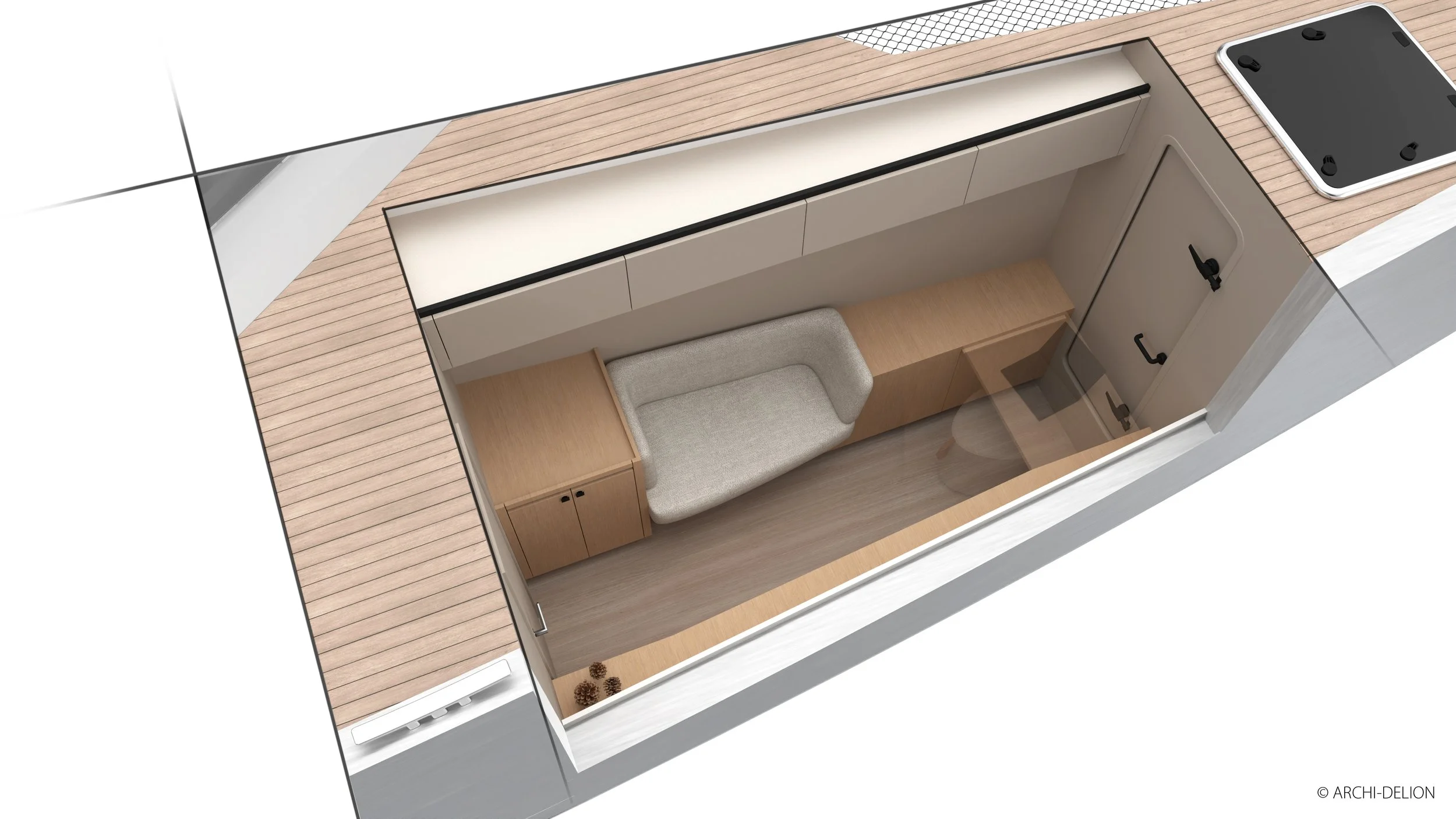

With Starlink, working from the water is no longer a compromise — it's a genuine alternative. The flex room exists because we've lived this, and we know that a dedicated workspace isn't a luxury on a long passage. It's what keeps you out there longer.
Why Aluminum
After 11 years and 1.5 circumnavigations — across the Pacific, thru Asia, across the Indian Ocean, around the bottom of Africa and across the Atlantic — we had one clear conclusion about what our next boat would be made of.
Aluminum. Without hesitation.
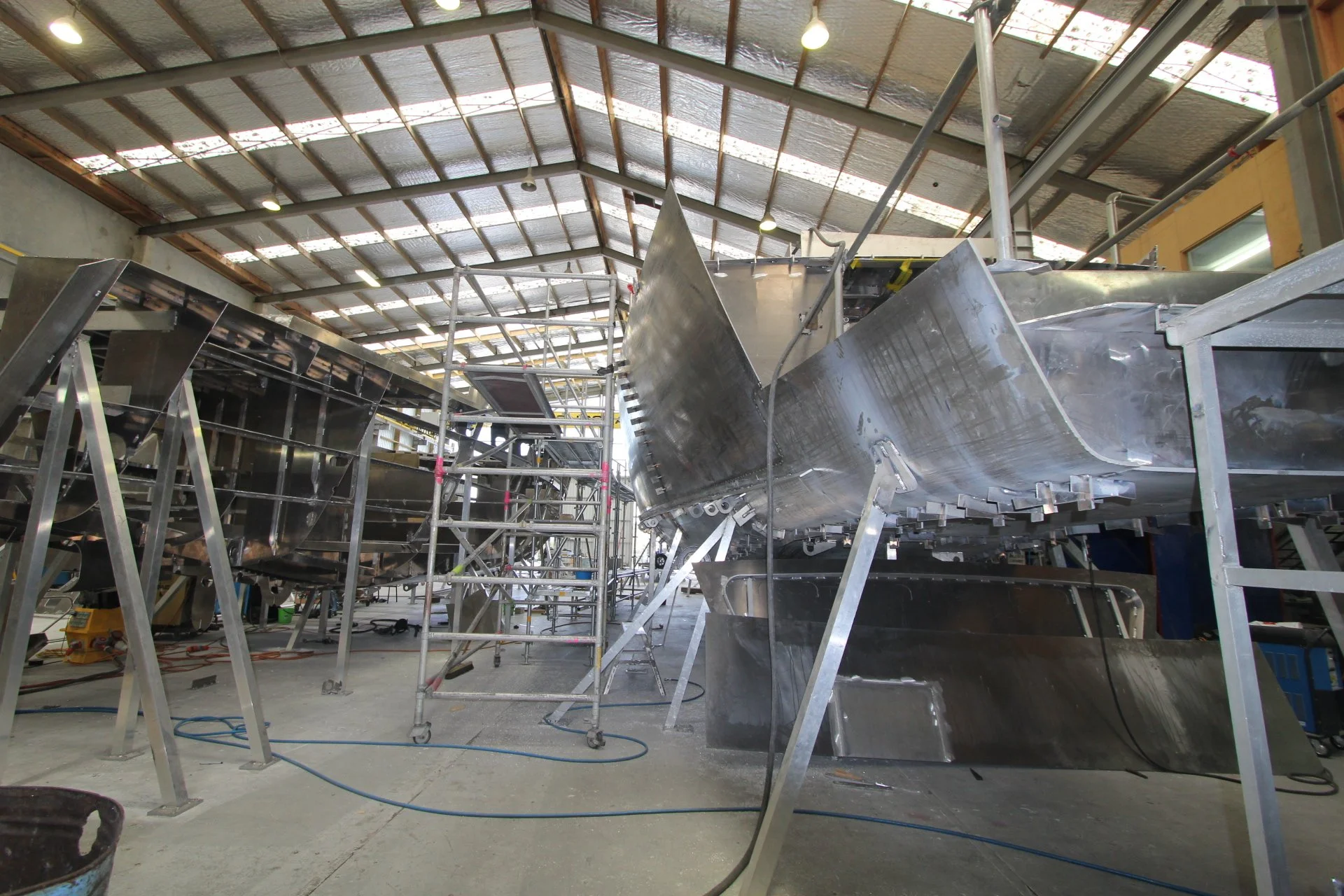
It is the material of choice for serious expedition vessels because it does what no other boatbuilding material does — it deforms before it breaks. In a collision, aluminum absorbs impact rather than shattering. It doesn't require constant polishing or osmotic blister treatment. Deck hardware is welded on, eliminating the leak points that plague fiberglass boats over time. And when something needs welding in a remote boatyard, a welder is never far away.
The Garcia Explocat, the Ovni range, the Dashew FPBs — the boats that have genuinely gone everywhere and come back are overwhelmingly built in aluminum. There's a reason for that. We built the Nahoa M the same way.
Insulation
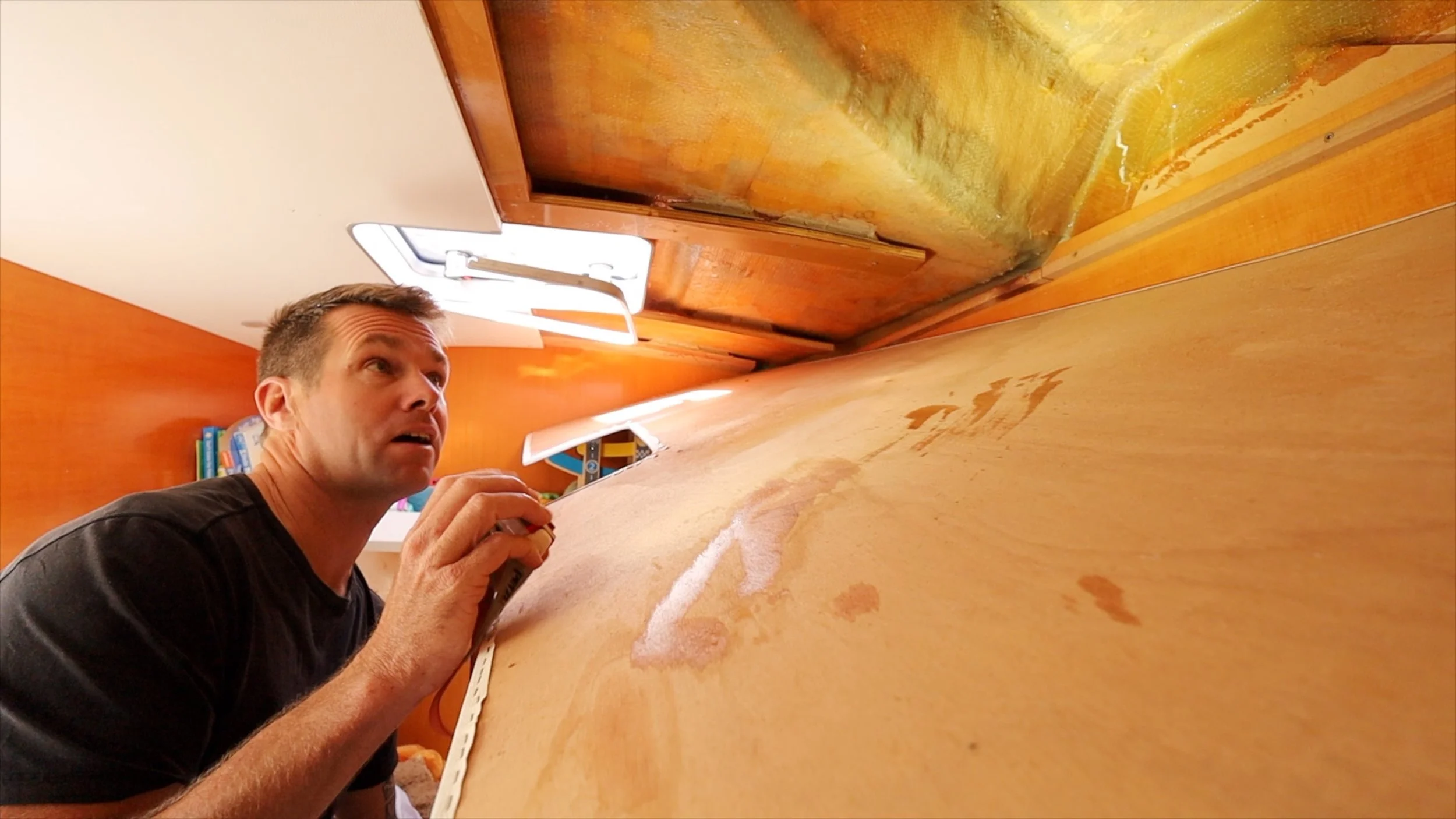
Condensation inside an uninsulated hull is one of those problems nobody warns you about.
Moisture builds behind liners, stains surfaces & causes mold.
Nahoa Yachts uses a two-layer system: Pyrotek Decicoat T35 thermal coating applied directly to the hull structure, followed by a minimum 50mm of closed-cell foam across all hull sides, bulkheads, decks, and coachroof. Engine room noise is treated separately with Pyrotek Decidamp SP150 and foil-faced acoustic insulation.
Dry in the cold. Cool in the tropics. Quiet underway.
Underwater Protection
The Nahoa M is designed to go places where help is not coming. Underwater protection isn't an afterthought — it's built into the architecture.
Shaft Drive Configuration
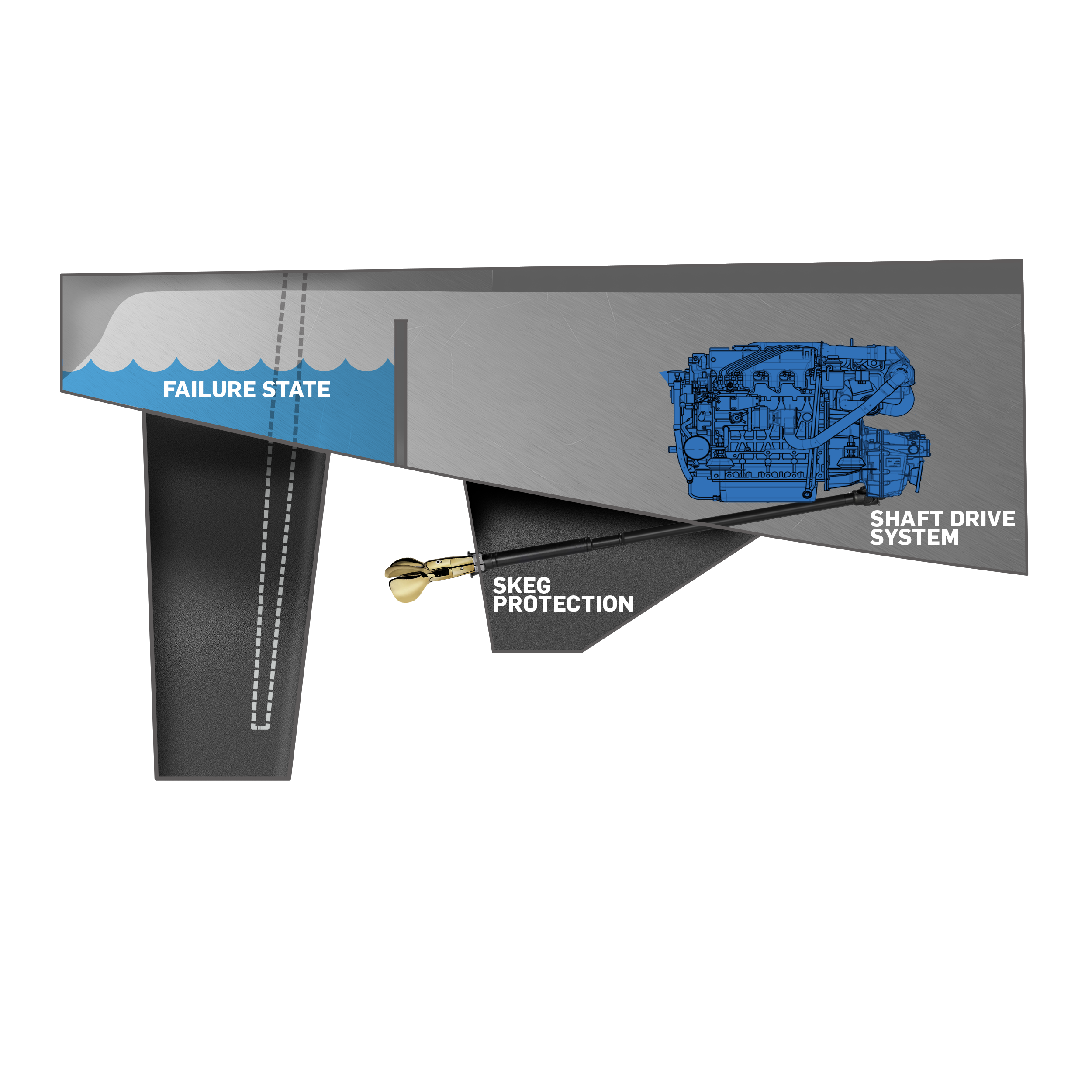
Saildrives require large-diameter openings through the hull — openings that rely on a rubber diaphragm to keep the ocean out. Offshore, in remote locations, that diaphragm is a single point of failure you cannot afford. The Nahoa M uses a conventional shaft drive with a V-drive transmission, eliminating that vulnerability entirely.
Skeg-Protected Propeller
The propeller and shaft are partially shielded by a skeg, reducing exposure to submerged debris.
Aft Flooding Control
If the rudder post is compromised in a collision, water ingress on most boats is unchecked. On the Nahoa M, a partial structural frame sits immediately forward of the rudder post — above the waterline — containing any flooding to the aft engine space and preventing progressive ingress into the rest of the vessel.
It is one of those features you hope you never need. We designed it anyway.